Tapio Anttila is a Finland-based designer and interior architect with an impressive range of award-winning products consistent in simplicity and aesthetic form, sharing an ecological sense of design.

As a designer, Tapio Anttila is particularly interested in Finnish wood and has a remarkable way of combining his passion for tradition with his love for simple and clean forms. This is reflected in the furniture of the ‘Tapio Anttila Collection’, which emit a sense of warmth and intimacy, as well as a subtle sense of humor.
His ‘Tapio Anttila Collection’ was established in 2005, after years of working as an in-house designer. Anttila’s clients include numerous Finnish and Italian companies, such as Riva 1920, and his products are available in design stores throughout Finland and around the world, for instance at the MOMA Design Store in New York.
Anttila’s work has been recognized, receiving many awards over the years. These include twenty Good Design awards for various products, three Green Good Design awards, and two EcoDesign awards for sustainable design. Additionally, this year he is going to be part of the jury of the Good Design Awards 2023.
He recently won a 2023 Prize Designs for Modern Furniture + Lighting award Organized by Global Design News and The Chicago Athenaeum: Museum of Architecture and Design. We had the opportunity to briefly meet during the award ceremony that took place on a delightful summer evening in Athens which then led to this very interesting interview.
Ecology is at the heart of everything I design and always comes first

GDN: You are a designer who focuses mostly on interior design and furniture. What is that you find exciting about working in this specific field of design?
Tapio Anttila: I’m an interior architect and designer and have spent the last 25 years making a living doing nothing but design. This is quite rare in Finland, as many designers do interior design, teaching, or exhibition design. I used to do interior design and that background has been a good basis for furniture design, as my furniture always has some connection to the space. I know this field well and how to fill in the “gaps” in the supply with my own designs.


GDN: FILTTI Lounge chair, which won a Prize Designs for Modern Furniture + Lighting, is a piece of furniture that is very comfortable and functional. These are characteristics that I believe are dominant in the pieces you design. Do you ever feel that you have to sacrifice other aspects in order to achieve them, or is it something that you pursue naturally?
T.A.: Good question. I’ve never felt that the previous characteristics limit me in any way. On the contrary, they inspire me and come naturally without being forced. The same has often been asked about commercialism, whether it limits my creativity. The answer is the same.

GDN: One can also notice a subtle sense of humor in your work. Is humor important to you?
T.A.: I think work in general should be fun – and especially creative work. You can’t force things to go forward, you must have a happy attitude. This is reflected in some of my work. I’ve blogged about myself on my website, where I open this side of myself and tell funny stories about my products.

I believe that the next generation must always improve on the innovations of previous generations
GDN: Your work has an elegant balance between nostalgia and simplicity. How do you achieve this equilibrium between this love for tradition and the need for innovation?
T.A.: In Finland, we have a rich culture and tradition of using wood in objects and buildings. We don’t even see or appreciate it enough. It is young and quite different from many other old cultures in the world. Our strength is that we are still quite close to nature. This is especially true for the forest; we Finns own a lot of it: either ourselves or our relatives or we know someone who owns a forest. So, the forest and the trees mean a lot to us.
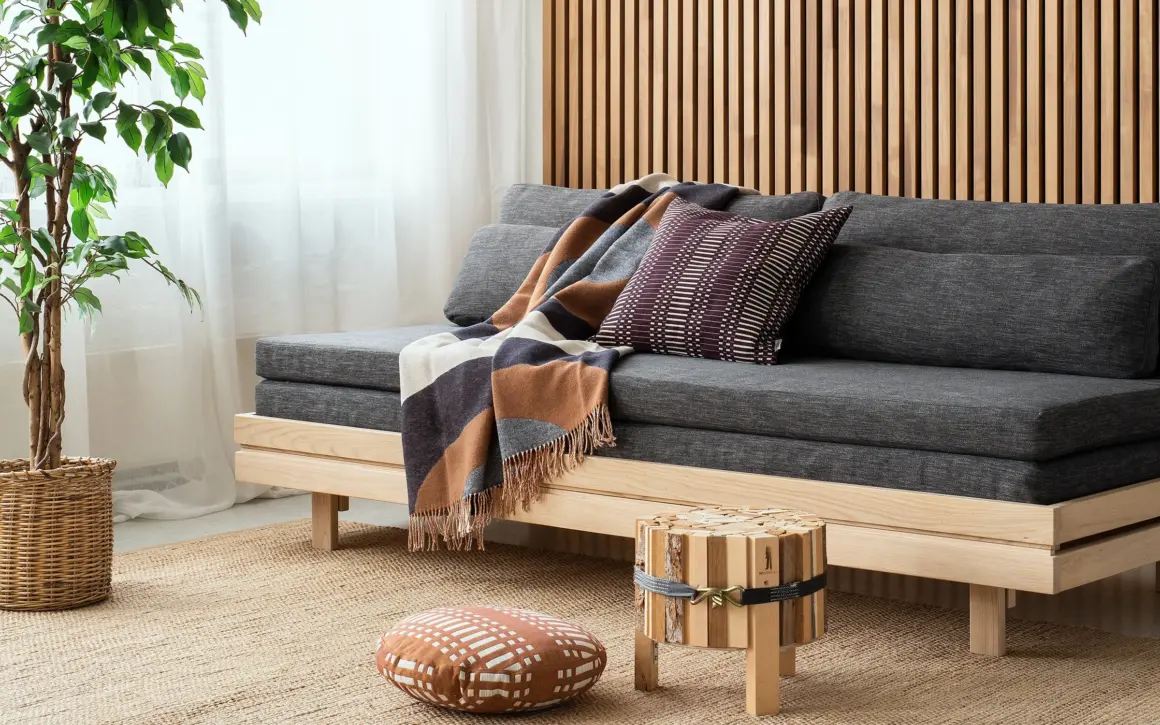
I believe that the next generation must always improve on the innovations of previous generations. You don’t always have to start from scratch to develop something new. The important question is whether the new product has enough of its own innovation or whether it is a direct borrowing from the old one and has been formulated in a slightly different way. This balance determines whether it is a new design. For my part, my sofa beds are the best example of this.
GDN: Speaking about tradition and innovation, what are your thoughts on Artificial Intelligence and its involvement in design?
T.A.: I’ve been following a lot of the development and possibilities of AI. So far, it has not convinced me with its ability to innovate. Design is essentially a question of the designer having to create something that does not yet exist. AI relies on processing data that already exists and combining them. It also lacks intuition (I’ve asked AI about this, and the answer was that it doesn’t…), which is one of the main strengths of a human designer that a computer is not yet capable of at all.

GDN: Tell us a few things about the ecological aspect of your design. How do you see yourself as a designer regarding sustainability?
T.A.: Ecology is at the heart of everything I design and always comes first. The designer is an important power user when designing a product. He decides the important things on the drawing board from the very beginning; what material to use, what is the manufacturing technique, how to package and transport the product, etc. These will determine the carbon footprint of the product.
We have purchased a calculator that calculates the carbon footprint of the product at each stage of the process. It shows us what emissions are generated at each stage. If an area looks bad, we can do something about it. So, the aim is to make products with as small a carbon footprint as possible. We then offset the emissions of all our products by planting trees in Finland. In addition, we use a lot of wood, which also acts as a carbon sink.
One very important issue is the longevity of the product. We make a lot of efforts to increase this, with quality materials, durable structures, and timeless design at the core. We also sell spare parts for our products, for example, spare upholstery parts are available for our sofa beds.
I think work in general should be fun – and especially creative work

GDN: Your furniture is made mostly of Finnish wood. Could you tell us why you chose this material? What does it mean to you personally?
T.A.: We still use quite a lot of European oak, but we are trying to make more and more of our products from Finnish woods such as birch and pine. The reason for this is that we want to open more transparency in our products, and we emphasize the origin of the materials and use certified wood. With Finnish wood, all this is easier.

GDN: Are there any other forms of arts or crafts that influence your work or your creative process?
T.A.: For me, inspiration comes from many sources. It’s hard to name one, because there are so many, and out of that mishmash comes an idea that eventually becomes a product. Perhaps the Finnish craft tradition is one that could be mentioned. In the past, craftsmen made objects largely based on the material and the user, and the word ‘design’ did not exist. Yet many objects are perfect; you can’t add anything to them, and you can’t take anything away from them. I strive for that same feeling with my own objects.