By Christian Narkiewicz-Laine
Alberto Alessi is Officially Bestowed the American Prize for Design Given in Conjunction with the Good Design 2025 program for His Bold Vision that has Transformed the Domestic Landscape for Homes across the Globe at the Presentation of the International Architecture Awards in Athens, Greece this September 20
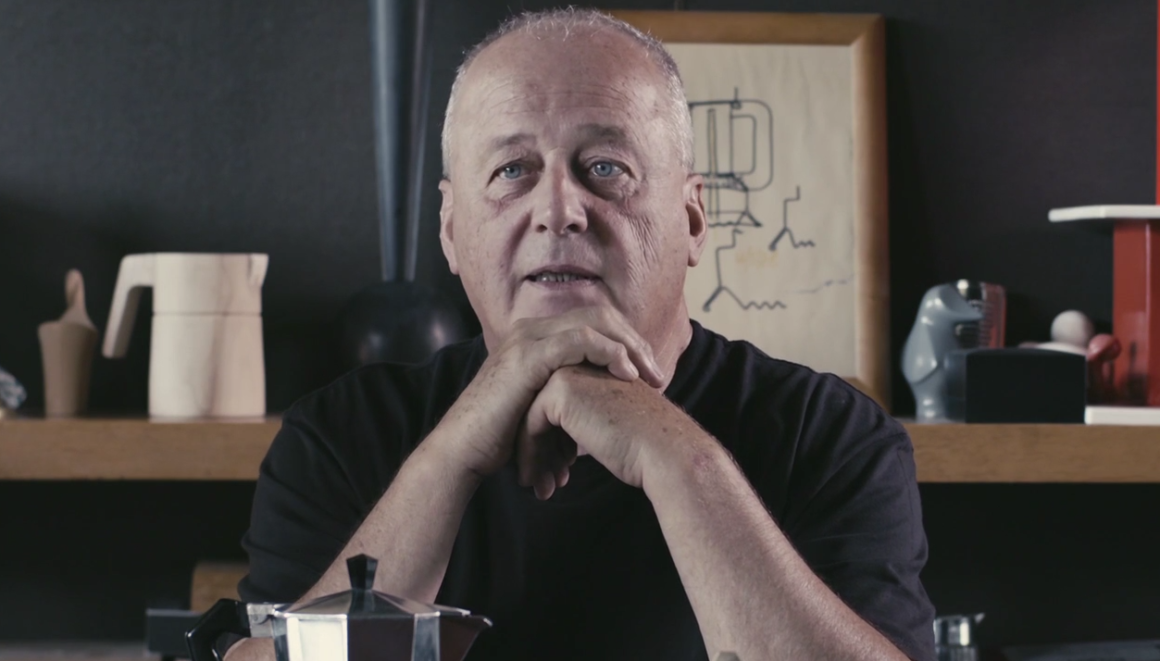
Originator of the world-famous brand with its colorful, most oftentimes, whimsical designer tabletop and kitchenware, 79-year-old Alberto Alessi has won the 2025 American Prize for Design for his leadership role in his iconic brand company, known for its visionary, if not revolutionary, housewares name, winning accolades worldwide, including numerous GOOD DESIGN® Awards from The Chicago Athenaeum over three decades.
For over 100 years, the Crusinallo di Omegna-based company and its designs have radically changed and challenged kitchens and dining rooms across the world with their bold, exceptional, ground-breaking, and one-of-a-kind design inventions, usually redefining an ordinary utensil such as nutcracker, salt and pepper grinder, orange/lemon squeezer, or pot and pan into an exceptional work of High Art.

Alberto, the renowned designer, manufacturer, and businessman, joined the family business, Alessi SpA in 1970, after completing his law degree, and deciding to make significant changes to the family company by rebranding the firm in order to give the company a new, more modern identity.
The result of this new identity in design has led, not to only the firm’s five decades of phenomenal success, but also to Alberto’s rich collaboration with over 900 designers across the globe.
Under his astute leadership, it has been of pivotable importance to the Alessi brand to create a multi-sensorial experience with their products.
Alberto preaches the poetic function of products and cautions designers against designing things that are too sophisticated, too over-designed.
He espouses the challenge of producing sculptural art objects for the mass consumer market.
Passion and intellect are what have guided Alessi to his Hollywood star quality success, making the firm synonymous with the best of GOOD DESIGN.
From the offset in the 1970s, Alessi looked at the practices of Italian design factories and reminisced about working with such artists as the Spanish painter Salvador Dali.
“The ability to see beauty, even in its nuances, is an ability of those who can understand and live in the present,” remarks Alessi—the visionary designer and entrepreneur.
“I have always thought that design is a creative discipline with an artistic and poetic matrix; in short, it serves to bring a little transcendence into our consumer society, to distinguish between function and emotion, to provoke surprise, and to move with the beauty of our objects,” Alberto continues.

The company was founded in 1921 by his grandfather Giovanni Alessi who later handed the baton to his son (and Alberto’s father) Carlo Alessi (b. 1916) and the company was called Fratelli Alessi Omegna—FAO, a “Workshop for processing brass and nickel silver sheet, with a foundry.”
FAO’s first production was inspired by the dictates of the most prestigious manufacturers of objects for the home of the early 20th-Century, particularly those from Austria and England.
Alessi’s grandfather, Giovanni was obsessed with quality and skilled craftsmanship: his products made of copper, brass and nickel silver, which were subsequently plated with nickel, chrome or silver, became immediately renowned for their meticulous crafting and perfect finish.
When Alessi was established, the focus initially relied on metal kitchenware.
When Carlo Alessi joined the company in the 1930s as chief designer, a new wave of experimentation was called forth.
Steering away from the utilitarian image of everyday household objects, Carlo introduced the use of stainless-steel and adventurous forms to Alessi’s industrial craftsmanship.
He is credited for most of the projects in the Alessi catalogue from the mid-30s to 1945, the year of the launch of his own designed post-War “Bombé” tea and coffee service (1945)—one of the archetypes of early Italian design and a rare and elegant example of mid-20th century craftsmanship.
When Alberto Alessi joined the company—his initial role was to handle the commercial section, the development of new products, and communication—he quickly traced what was missing in the company and decided to fill the gaps head-on.
Alessi with the help of his team worked on new packaging, graphic design, and changed the company’s factory premises and offices.
For the products, he began to work with talented architects, designers, artists, and sculptors in order to make fashionable products at affordable prices.
Under Alberto’s leadership, a new set of iconic products immediately emerged: the 5070-condiment set design by Ettore Sottsass; Juicy Salif citrus squeezer by Philippe Starck; Whistling Bird Teakettle by Michael Graves; and La Cupola espresso coffee maker by Aldo Rossi.
Alberto’s entry into the company ushered in a new era of joy as an “entrepreneur by mistake” spearheading the inclusion of international designers into the Alessi universe—virtually a “who’s who” in international design.
A history that is also an immense cultural project.
The collaborations resulted in thousands of products over the decades, many of which have become icons of contemporary design well into this decade.
“I had been very lucky that from the 1970’s on that I had the possibility to meet and work with some of the best Italian design maestros, people like Ettore Sottsass, Achille Castiglioni, Richard Sapper, Aldo Rossi, Alessandro Mendini, and so on,” states Alessi.
However, it was his long-term collaboration and friendship with Alessandro Mendini that pushed the envelope on the avant-garde designs and products produced by Alessi during those formative years and onward to the present.

With Mendini, the list of other impressive designers that marched through Alessi studios and factories included Michael Graves, Philippe Starck, Richard Sapper, Michele Di Lucchi, Virgil Abloh, Enzo Mari, Frank Gehry, Guido Venturini, Fratelli Campana, Karim Rashid, Inga Sempé, Zaha Hadid, Patricia Urquiola, Ronan and Erwan Bouroullec, Doriana and Massimiliano Fuksas, Toyo Ito, Mario Bellini, Stefano Giovannoni, Naoto Fukasawa, Fernando and Humberto Campana, Kristina Lassus, Marcel Wanders, Mario Trimarchi, Riccardo Dalisi, and Miriam Mirri—each architect and designer leaving an indelible fingerprint on every Alessi designed object and on modern and postmodern design history
Alessi strives to act as a bridge between international creativity and the public, society, and market, transforming these creative expressions into tangible items that meet people’s dreams and imaginations.
“Everything,” states Alessi, “is strongly influenced by the present and our sector, that of design, is certainly not excluded, on the contrary.”
“The mission and nature of a company like ours is to be a mediator between the best expressions of contemporary creativity at an international level and the desires of the public.”
“This mediation practice gives rise to objects that are true interpreters of their time. It is therefore necessary to understand the present (among many other reasons) in order to interpret it,” expounds Alberto.
As a talented manufacturer, businessman, and design leader in his own right, Alessi has spoken and written extensively about his experience working in product design and management.
Today the company has expanded and is made up of an eclectic range of home products that include tableware, cooking utensils, watches, furnishing accessories, lighting, and small domestic appliances—all known to reflect the timeless elegance and meticulous design for which the Alessi brand is known and celebrated.
Given in conjunction with the Museum’s historic GOOD DESIGN Awards, which were founded in Chicago in 1950, this Prize honors a specific design practitioner with the highest accolade for producing design that promotes design excellence, innovation, and lasting design.
Candidates for the Prize are sent to The Chicago Athenaeum by design practitioners, press, and educators from around the world and the Museum’s International Advisory Committee, composed of such notable world designers as Richard Meier, Adrian Smith, John Marx, James von Klemperer, Santiago Calatrava, Sergei Tchoban, Graft Architects, and the late Alessandro Mendini.
The Committee’s decisions are based on core criteria: design excellence, innovation, and contributions to humanity and to the public good.
The American Prize for Design is the highest and most prestigious design award in the United States.

Previous Laureates include Gorden Wagener, Mercedes-Benz Chief Designer and Executive Vice President at Daimler AG., British architect/designer Sir Norman Foster, Chris Bangle, Flavio Mazoni, Karim Rashid, Mario Porcinci, and Stacy Wolff.
Last year, Paolo Pininfarina was bestowed this prestigious tribute.
This year’s public accolade to this visionary Italian designer/manufacturer Alberto Alessi is long overdue.
Born in Arona (Novara), Italy, in 1946, Alberto Alessi is president of Alessi SpA and serves as the firm’s head of marketing strategy, communications, and design management.
He was educated as a lawyer but in 1970 took the helm of the Alessi brand.
He has written various books on his experience working in product design and management including La Cintura di Orione (Longanesi, Milano 1986); Not in Production next to Production in 1988 (Prototypes and drawings of 58 designs never entered in the Alessi production catalogues from 1921 to 1987); and The Dream Factory: Alessi since 1921 in 1998.
He has also written for well-known international publications on product design and is a visiting lecturer at design colleges around the world.
After dedicating his professional time to Alessi SpA., making it the company it is today, Alessi achieved the Design Award for Lifetime Achievement from the Brooklyn Museum of Art and the Collab’s Design Excellence Award at the Philadelphia Museum of Arts. He has also received an Honorary Degree of Doctor of the University at the UCE in Birmingham in 2001, and in 2010, he gained an Honorary Doctorate of Arts at the Lincoln University. He is on the board of the University of Industrial Arts in Helsinki and he is also on the Honorary committee of the Design Museum in London.
Alberto Alessi curated the exhibition The Dream Factories: People, Ideas, and Paradoxes of Italian Design Factories at the Triennale Design Museum in Milan 2011-2012.
The exhibition illustrated Alessi’s vision and analysis of what he refers to as the “factories of Italian design.”
Alberto Alessi’s extensive contribution to creative research began in 1970 when he started collaborating with the “Exhibition Design” group (a kind of “community of ideas” that included Bruno Munaria and Mario Bellini) and with designers Franco Sargiani and Ejia Helander.
Alessi’s idea was to dream big: to create objects capable of communicating poetry; and for this purpose, from 1972 to 1977, he planned to produce art multiples under the label “Alessi d’Après”—a research-oriented approach that, over time, would lead the company to collaborate with more than 900 designers worldwide.
For Alberto, this would be a history that is not only a huge design initiative, but also an enormous cultural project.

In the 1970s, after these initial projects, more partnerships were formed together with Ettore Sottsass, Richard Sapper, Achille Castiglioni, and Alessandro Mendini, transforming the company into the “Factory of Design” imagined by Alberto.
In the first half of the 1980s, the partnership with Alessandro Mendini triggered the research operation entitled “Tea & Coffee Piazza,” which aimed at exploring the world of international architecture to identify new talents capable of renewing the language of design that characterized objects for the home.
The theme proposed to eleven architects involved the “Tea and Coffee Set” to investigate the spatial and architectural reimagining of the tea and coffee set with the tray serving as the “piazza” and the vessels positioned like “buildings.”
The results of the “Tea & Coffee Piazza” research were presented in 1983 and hugely successful with the public and critics alike, jettisoning the Alessi brand firmly among the top Factories of Italian Design.
The operation also led to the discovery of two great new designers: Aldo Rossi and Michael Graves.
The Graves design was one of the most popular in the series, with its whimsical mixture of Greco-Roman architectural forms that evoke fluted classical columns; splashes of vivid color; and clean, postmodernist design simplicity.
In the 1990s, Alessi started to work more with plastics, at the request of designers who found it an easier material to work with than metal, offering more design freedom and innovative possibilities.
The 1990s were marked by the theme “Family Follows Fiction,” with playful and imaginative objects.
Architects designing for this theme included Stefano Giovannoni and Alessandro Mendini, who designed Fruit Mama and the best-seller Anna G.
Metal still remained a popular Alessi material, for example the Girotondo family by King Kong.

In the 1990s, he opened Centro Studi Alessi (CSA) with a dual mission: to develop theoretical contributions on matters linked to objects and to coordinate the work that the company wanted to launch with young designers, no longer only those who already had a consolidated reputation.
During that time, Alessi’s research opened the doors to new design languages and some of the icon-products of the time were created, including the Firebird gas lighter by Guido Venturini or the Mary Biscuit container by Stefano Giovannoni.
Other materials were brought into production alongside steel which had been used almost exclusively until then. The catalogue was enriched with objects made of wood, plastic, glass, porcelain, and ceramic.
The “Tea & Coffee Towers” design operation reopened the 2000s, following the same theoretic assumptions as “Tea & Coffee Piazza,” 20 years onward.
Once again, the theme proposed to the architects involved was the “tea and coffee set,” but reducing their large-scale design visions to a smaller scale.
The operation launched a new series of partnerships, including those with David Chipperfield, Doriana and Massimiliano Fuksas, Zaha Hadid and Toyo Ito, bringing the eclectic character of the Alessi catalogue to full maturity.
“All the knowledge and expansions of the previous catalogues,” noted Alessandro Mendini, “was furthered, amplified and reinterpreted with a dilation and proliferation of products that had never been experienced at any time previously throughout Alessi’s history.”

In 2000, Alessi launched partnerships with companies operating in production sectors very different from its own, offering great experience in the development of research in the design field.
In the 2010’s, Alessi’s research over the past decade had developed between two points, defined by Alessandro Mendini as “ethical” and “radical.”
“Ethical,” considered as a leaning towards a new simplicity, and an austere kind of design. “Radical,” on the other hand, indicates the search for strongly expressive and decorative forms.
Designs with a “radical” imprint (by Mendini or Marcel Wanders, for instance) and those with an ethical tendency (such as those of Naoto Fukasawa or David Chipperfield), can be read according to this dichotomy, despite the diversity of their languages inviting us to reflect on the relativity of this classification.
The distinction between “ethical” and “radical” is a partial attempt to try and define the much more complex reality of design as an artistic and poetic creative discipline.
According to Alessi, these factories have developed a series of highly specific artistic intermediation practices, which are among the best expressions of international contemporary product design on the one hand, and of the market, on the other.
In 2016, Alberto wrote the “Six Principles of Good Design” for The Chicago Athenaeum: Museum of Architecture and Design and the historic GOOD DESIGN Awards Program highlighting: “Do Not Create a Style,” “Take your Cue from Architecture,” “Reflect the Times,” “Don’t be So Serious,” “Design is More than Function,” and “Design for What You Love.”
In 2018, Delta Air Lines’ premium travelers—Delta class, first class, and Delta premium select—fly in style as the Atlanta-based airline announced their partnership with Alessi for 86 unique service ware pieces called the “Alessi for Delta Collection.”
The set sees an array of big-name designers that include Patricia Urquiola, Ronan and Erwan Bouroullec, Stefano Giovannoni, Fernando and Humberto Campana, Kristina Lassus, and Miriam Mirri marking the first time the Alessi company, known for innovative and unique designs, have appeared in flight with a major airline and with such a comprehensive design program.
In 2020, with a special exhibition at the Salone del Mobile and 12 new projects, the Alessi brand celebrated one hundred years of research in the field of the applied arts and the beginning of a new century of experimentation.
In 2021, Alberto completed the centenary celebrating 100 years of design excellence at Alessi; and to mark this milestone, the company announced the ALESSI 100 Values Collection comprising 12 values, 12 months, and 12 unpublished products with deep roots.
During the course of one year, the firm announced the presentation of one object every month drawing from inspirations that were never realized, research samples, and new versions of signature classics.
The 12 values—Industrial Craftsmanship, Art, Paradox, Beyond, Hybridization, Research Lab, Irony, Borderline, Poetry, Thingness, Transgression, and Futurespective—are pivoted on the brand language of Alessi and the company’s remarkable history.
ALESSI 100 Values Collection presented the genesis of these values and what makes them all unique in their own right.

Most recently, Alessi has added a new dimension to its design platform: sustainability.
In 2014, Alessi reintroduced Mendini’s iconic 1994 Anna G. corkscrew and its second corkscrew Alexander M. that completed an iconic couple.
However, this new 2024 reintroduction was launched in a new creative and technological exploration—a project that goes beyond using an innovative sustainable biocomposite.
Along with Mendini’s redesign other hybirdizations were introduced by Arthur Arbesser, Studio Tempo, and Fluvia Mendini—daughter of Alessandro.
The Alessi Tables Collection won a 2025 Green GOOD DESIGN Award from The Chicago Athenaeum.
“The ability to see beauty,” states Alberto, “even in its nuances, is an ability of those who can understand and live in the present.”
“I have always thought that design is a creative discipline with an artistic and poetic matrix; in short, it serves to bring a little transcendence into our consumer society, to distinguish between function and emotion, to provoke surprise and to move with the beauty of our objects,” he continues.
“A good idea, a beautiful object, a good friendship, and why not (I speak here as a wine lover and producer) even a good tasting be born.”

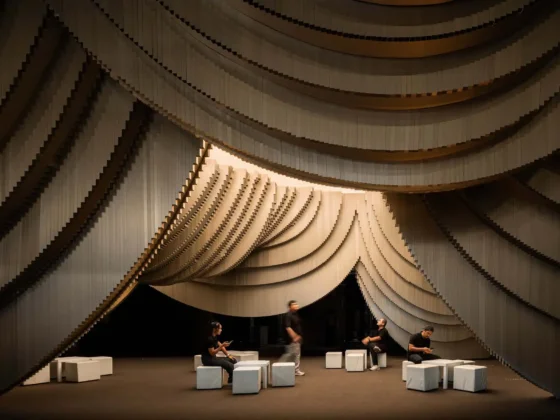
On September 20, Alberto Alessi will receive the 2025 American Prize for Design at the presentation of the 2025 International Architecture Awards at The European Centre for Architecture Art Design and Urban Studies in Athens, Greece.
Tickets for the dinner and award presentation are available by contacting Konstadina Geladaki, Director of Communications at +30 210/342 8511 or by email at konstadina@europeanarch.eu.