Paris, France
“Eastern Paris is slowly coming into focus, building up and taking form, completing and modifying an unfinished context,” states Jean Nouvel.

“This project is about building its summit, its culminating point for the beginning of the century. It is also about creating a character, a singularity that is in relation with the reality of the site, that reveals its particular beauty, that relies on it to invent and strengthen the attractiveness of the place.”
Jean Nouvel and his design team at Ateliers Jean Nouvel have completed the Tours Duo–two leaning skyscrapers designed as an immediate landmark in eastern Paris for developers SEMAPA, Hines, Ivanhoé Cambridge, and Natixis Assurances.
The project features a pair of colossal towers containing 97,000 square meters of office space and a 139-room hotel with interiors designed by French designer Philippe Starck.
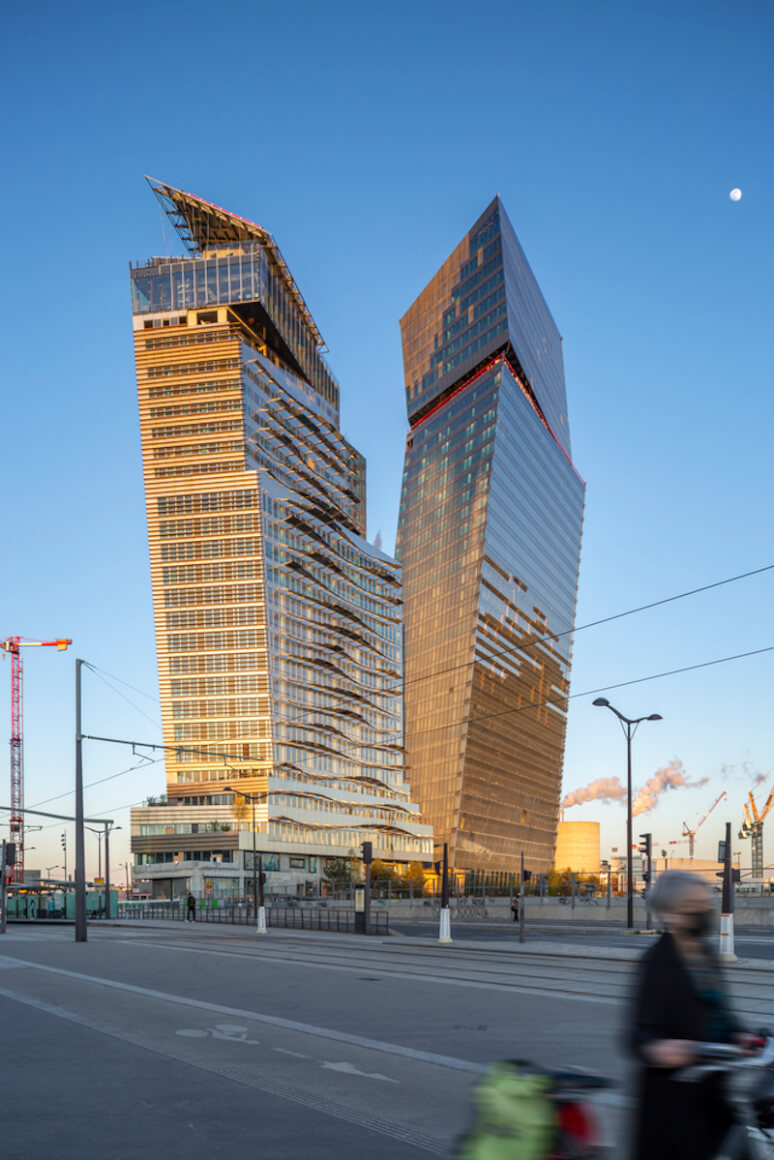

Built alongside the Périphérique ring road and a large railway siding, the pair of skyscrapers both bend away from a central plaza.
A true continuum between the cities of Paris and Ivry, they create a new urban landmark for one of the major districts of Greater Paris.
The towers rise above the Paris ring road at the entrance to the Bruneseau neighborhood in the 13th arrondissement, close to leading universities, the Bibliothèque Nationale de France, and the Station F start-up campus.
At 180 meters high, Tour Duo 1 is the second tallest skyscraper in Paris after the Tour Montparnasse.
The 39-story building contains offices on its upper levels with an auditorium and shops on its ground floor.


The 29-story neighboring tower contains office space along with a hotel on its upper floors. It is topped with a restaurant and bar that has a terrace with views across Paris.
According to Nouvel, this project is about building a summit, a culminating point for the beginning of the century in the City of Paris.
It is also about creating a character, a singularity that is in relation with the reality of the site, that reveals its particular beauty, that relies on it to invent and strengthen the attractiveness of the place.
Three parameters were taken into account by Nouvel to orient the project:
The perspective of the Avenue de France; the location adjacent to the river of rails that lead into the heart of the city; the location adjacent to the Paris ring boulevard, from which the project can be seen as an identifying landmark.
The site does not have landmark status in the perspective of the Avenue de France.
It is not visible from the sidewalk of the Bibliothèque Nationale de France.


A slight inclination easily made the towers come into view while enabling the architectss to play a game with the reflections of the railway landscape in the south façade, which would be very visible from the ring boulevard and the boulevard du Général Jean-Simon.
Placing the tower nearer the ring boulevard increased its presence in the perspective of the Avenue de France.

It became most expressive when placed directly adjacent to the ring boulevard, its inclination giving a very visible dynamic seen from the boulevard.
The consequence of positioning the first tower in this way is that the second tower is then situated along the boulevard du Général Jean-Simon.
In this position it became more urban, more human. It can have shops at ground level, accessible terraces, and operable windows shielded from the sound and dust pollution of the ring boulevard.
The essential principle of the urban program—the transverse fracture and the creation of a central plaza between the two buildings that preserves views toward the Berliet industrial building—is respected and accentuated by the inclined buildings which cooperate to form an open “V” of sunlight.
These are urban buildings; at ground level, the public balcony overlooking the railway faces Ivry; along its edge is a large brasserie with a terrace.
The terrace gives access to the hotel and the office tower and accommodates shops in the form of kiosks that rhythm the large space at the intersection of the avenue de France and the boulevard du Général Jean-Simon.


These two buildings aim at increasing the pleasure of being in this place.
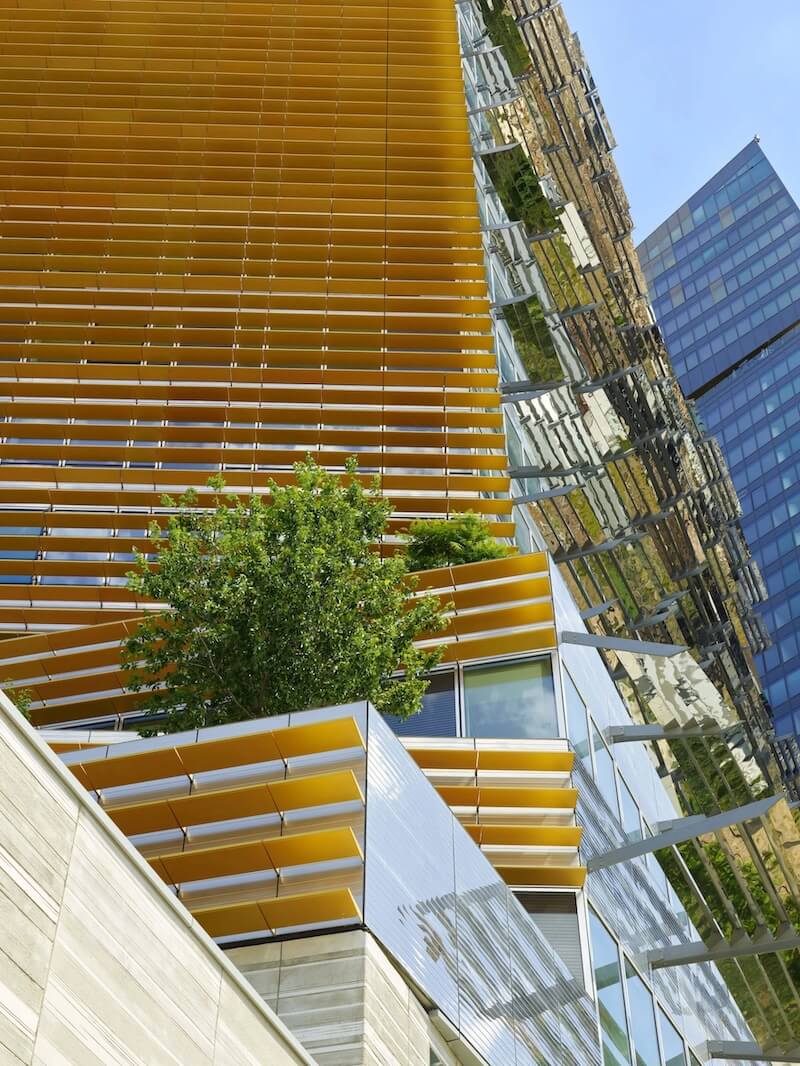
They seek out views and accommodate vegetation on their terraces.
The hotel offers a panoramic restaurant and a large roof-covered terrace facing the Seine and historic Paris.
The summit of the office tower features a panoramic meeting space as part of the development program.
The tall buildings of past decades are headless; their roof terraces are not accessible. ” By contrast, Nouvel proposed a summit and even two summits.
A summit has a head and an identifiable profile.
That is why the heads of these two actors are expressive and alive, and why they speak to one another and also to their friendly neighbors.



Project: Tours Duo
Architect: Ateliers Jean Nouvel
Lead Architect: Jean Nouvel
Studio Manager: Didier Brault
Project Managers (Competition): Marie-Hélène Baldran and Ingrid Menon
Project Managers: Vincent Chaigneau, Laure Frachet, and Kirsi Marjamaki Mas
Competition Team: Romain Caillon, Vincent Chaigneau, Chen Chen, Laetitia Degroote, Freddy Laun, Athina Lazaridou, Kirsi Marjamaki Mas, Anita Peboeck, Rui Pereira, Cristina Perez, Marianne Prouve, Nathalie Sasso, Maximilian Schlechtingen, and Martin Tegaldo
Project Design Team: Romain Caillon, Vincent Chaigneau, Chen Chen, Laetitia Degroote, Freddy Laun, Athina Lazaridou, Kirsi Marjamaki Mas, Anita Peboeck, Rui Pereira, Cristina Perez, Marianne Prouve, Nathalie Sasso, Maximilian Schlechtingen, and Martin Tegaldo
Construction Team: Lydie Bot, Lily Bouchez, Lucie Calzada, Sophie Catalano, Valeria Colavita, Laetitia Degroote, Ana Gutierrez Diez, Tristan Israël, Jérôme Leclerc, Bianca Nenciu, and Marianne Prouve
Interior Design Team: Sabrina Letourneur and Marie Orhon
Landscape Design Team: David Euvrard, Isabelle Guillauic, Laura Giulian, and Chloé Eckert
Interior Architects: Philippe Starck
Landscape Architects: Technivert
Structural Engineers: Egis + Aedis
Façade Engineers: Eppag
General Contractors: Bateg, Groupe Vinci, and Construction France
Co-contractors: Vinci Energie (Building Services), Perma Steelisa (Facades), and Otis (Vertical Circulation)
Developer: SEMAPA
Associate Developer: Hines France
Investors: Ivanhoé Cambridge Europe and Natixis Assurances
Photographers: Roland Halbe