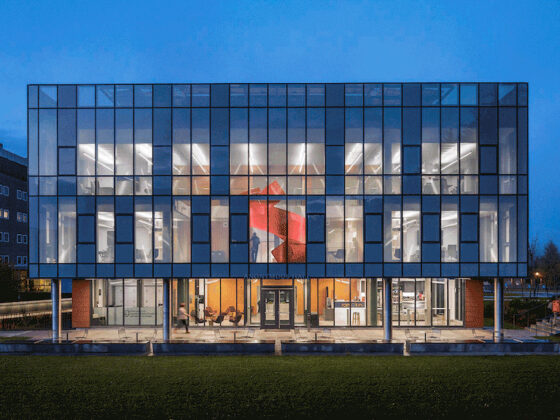
Dublin, Ireland
70 St. Stephen’s Green, a development of a brownfield site in Dublin City Centre by Wejchert Architects for Irish Life Assurance Plc, is a workplace with exceptional sustainability credentials.

In addition to providing an attractive well-tempered workplace, it has achieved the highest energy and environmental standards: BER A3, LEED Platinum, WELL Gold, WIRED Gold, and Near Zero Energy Building Standards (NZEB).
For its green achievements, 70 St. Stephen’s Green has recently been awarded a 2022 Green Good Design Award by The Chicago Athenaeum: Museum of Architecture and Design and The European Centre for Architecture Art Design and Urban Studies.
To achieve such high standards, the design includes inter alia photovoltaic panels on the roof, a sedum green roof, rainwater harvesting, air-to-water heat pumps, and an ice bank.
As is also required by this accreditation, waste during construction was assessed and minimized.

The new multi-story office building is a careful insertion into its urban context in the city center.
It is on an attractive plot that faces St. Stephen’s Green to the south, a large and popular park that has mature trees.
The carefully designed floorplan contributes to comfort, health, and well-being with panoramic views of St. Stephen’s Green that are maximized by full glazing.
Glazing toward the central recess courtyards brings daylight and sunlight to the center of the floor plan.

In all, 75% of the office area is no more than five meters from a window and daylight.
Heat gain through the glass is limited by the use of interstitial blinds on the south-facing facade.
The building fabric meets the WELL limits on VOC emissions, and all finishes, fittings, and furniture were selected to minimize VOCs.
Paint was avoided in corridors by using large-format ceramic tiles, and all timber products are low formaldehyde to En717-1:2004.
This care toward minimizing and monitoring emissions was applied during construction as well.

Individual control over one’s working environment is achieved by providing local lighting control to over 90% of the building occupants to suit individual task needs and preferences.
In addition, there is local control for multi-occupant spaces to cater to work needs and preferences.
Similar controls for heating/cooling are provided: individual comfort controls are provided to more than 50% of occupants plus individual controls of multi-occupant spaces enable adjustments that meet those occupants’ needs and preferences.
Glare from lights is managed by calculation, selection of appropriate light fixtures, and shading techniques.

Reduced glare improves the visual experience for the occupants, increasing comfort and reducing the risk of fatigue and headaches.
The building is 37% more energy efficient than an ASHRAE (US-based energy standard) baseline, and the project offsets 1.48% of the total energy costs through renewable energy generated on-site.
The well-insulated fabric and airtightness achieve minimized energy demand.
The building is air-conditioned and has an effective airtightness value of 3W/m2/m2 @ 50Pa.

Air temperature, radiant temperature, airspeed, and humidity are included in the air-vac system and monitored during use.
Fresh air with a heat recovery system is introduced to all occupant areas, and MERV 13 filters are installed on the air handling units and maintained regularly.
Additional measures to ensure the system operates to its best include the installation of CO2 sensors in occupant areas.
Plant design includes installation of access for cooling coil inspection to check on non-interstitial condensation and assist in mold and microbe control.

Minimum indoor air quality performance meets section 4-7 of ASHRAE 621-2007. ASHRAE standard 55-2004:
• Regulated operational carbon emissions: (KgC02/m2/annum) BER: 15.68 kgCO2/m/yr.
• On-site renewable energy contribution: (kWh/m2): 9.62Kwh/m2.
Water usage is minimized by the selection of low water usage fittings, and by water harvesting on the roof that is used as greywater in WCs, resulting in a 31.5% water use reduction.
The project provides fundamental water quality that meets thresholds for turbidity and coliforms for drinking and other uses and verifies standards by regular on-site tests.

The façade material chosen for the elevation facing St. Stephen’s Green is dressed stone in order to respect the neighboring buildings and acknowledge the urban setting for this project.
The double-height entrance hall provides continuity and invites transparency.
The building’s structure is reinforced concrete and includes a double basement.
The mid-terrace location and the resulting high thermal mass have a good heat response, responding gently to daily and annual thermal changes, which are more comfortable for occupants than sharp rises or falls.
The entire footprint of the plot was used, extending it down by two floors, and adding a floor at the roof level, allowing for a vista down St. Stephen’s Green.

The site is adjacent to the Luas (electric tram), and bus lines, within 500 meters of the railway line, and cycle lanes; it is thus very well served by public transport.
Parking is limited and electric charging points are provided.
Bicycle parking and showering facilities are provided in the basement, and a gym for fitness is included.
The building limits disruption of natural hydrology by reducing impervious cover, increasing on-site infiltration, reducing or eliminating pollution from storm-water runoff, and eliminating contaminants.
By placing the carpark underground and through the selection of reflective materials on the roof, the project reduces the heat island effect to minimize impacts on microclimates and human and wildlife habitats.

Innovations include improvements in plant and technical systems, but longer-lasting innovations are those that pass on the “green” message and give active encouragement to others to follow suit.
Tenant behavior management also has a significant effect on energy demand and CO2 emissions of the building, in policies and procedures that affect the quality of the workplace for staff.
Thus, a handbook has been prepared for the tenants that explains the aims of WELL and LEED, describes the measures taken in the building in non-technical details, shows how to build on these to achieve the same standards for the fit-out, and in general, gives encouragement to the tenant group to follow the highest standards.
Additional meters were also installed to assist in this tenant application: the Green and WELL features in the building, e.g., biophilia, art, bicycle parking, gym, and information monitor in the circulation areas informing of events and activities.

Project: 70 St. Stephen’s Green
Architects: Wejchert Architects
General Contractor: John Sisk & Son Ltd.
Client: Irish Life Assurance Plc.