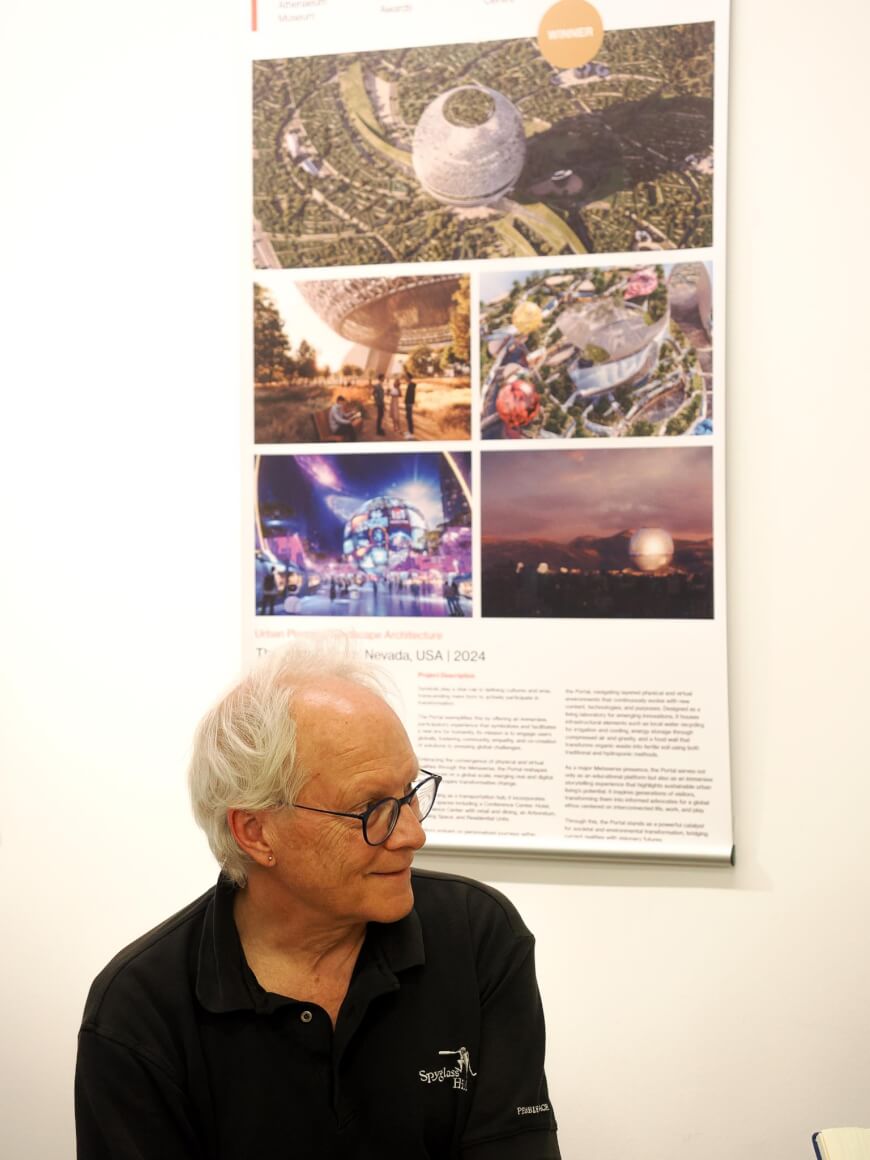
John Marx, AIA, is the co-founding principal and Chief Artistic Officer of Form4 Architecture in San Francisco. Renowned for blending philosophy, art, and poetry into architecture, he champions a return to emotionally resonant, human-centered design. John’s work redefines Modernism through his upcoming book, Second Century Modernism, which calls for a deeper emotional connection in architecture. With over 174 design awards, -in 2017, John became a Laureate of the American Prize for Architecture-, international exhibitions including the Venice Architecture Biennale, and numerous lectures worldwide, John’s visionary approach embraces creativity, sustainability, and cultural vibrancy. His projects and writings have inspired new directions in design, making architecture a poetic and meaningful experience. John Marx has won an International Architecture Award for 2025 for his work on “The Portal” project.

GDN: Can you please share some key qualities of the project?
John Marx: The project is called The Portal, and it really embodies its name — it’s a literal and conceptual portal into the metaverse. Architecturally, it’s a massive 400-meter-tall sphere, completely hollow inside, with the entire inner surface covered in LED panels. This allows the entire environment — walls, ceilings, everything — to transform into immersive digital landscapes. You could be in Venice one moment, then Antarctica the next. It’s about fusing the physical and virtual worlds — which is the essence of what the metaverse aims to be.
Inside the sphere, there’s a walkable, small-scale city or neighborhood. It’s a place where people can interact whether they’re physically present or joining through augmented or virtual reality. So for example, someone wearing VR goggles in Hong Kong can appear — somewhat ethereal — to someone standing in the Portal in person. You can walk and explore together, creating that emotional sense of connection despite being miles apart.
At its core, the project is a research experiment — not just in tech, but in human experience. It’s based on research I’ve been doing since 2001, including a course I taught at UC Berkeley called Placemaking in Cyberspace. Back then, we were exploring how traditional architecture applied to virtual spaces, using early platforms like Second Life. This project takes that thinking much further by merging real and digital environments into a shared, interactive space.
Another key aspect is the organization of experience at scale. We imagined 40,000 people inside the sphere at once — which poses obvious challenges. So we integrated an AI-based concierge that dynamically choreographs movement and activity. For instance, it ensures that a yoga session doesn’t get interrupted by a nearby gaming group. It’s all about keeping diverse experiences flowing harmoniously within one space.
Beyond the sphere, we also designed a surrounding city for 200,000 people — a creative community inspired by Burning Man. Most urban planning focuses on “live, work, and play,” but we wanted to go further and include “learn” and “create” as essential ingredients. At Burning Man, people express themselves in the most unique and unfiltered ways — and that spirit of participation, kindness, and creativity informed the urban design here.
That brings me to another core quality: emotional connection. I always ask a question in urban planning forums that no one seems to answer — “Why should you love this city?” There’s so much focus on sustainability and functionality, but not enough on creating spaces that people genuinely feel emotionally connected to. We’ve become too focused on rational thinking in architecture, and not enough on intuition, care, and beauty.
So a big part of this project — and my approach in general — is about restoring balance. Between physical and digital, logic and emotion, masculine and feminine energy. Architecture needs both structure and soul. This project is a step toward that — creating not just a futuristic experience, but one that people can love, participate in, and feel fully human within.

GDN: How do you envision the future of architecture in relation to urban development and technology?
John Marx: I think the future of architecture really depends on rebalancing — between technology and humanity, and between logic and emotion. Over the last century, especially since the founding of the Bauhaus in 1919, architecture has largely followed a modernist path rooted in abstraction and intellectual ideas. That brought a lot of innovation, but also a kind of emotional detachment from buildings and cities.
In my recent work — like my book Second Century Modernism — I argue that in this next century, we should complement that abstraction with what I call emotional abundance. This means designing spaces that people can actually connect with emotionally — buildings that are beautiful, joyful, even lovable. But as a profession, we tend to avoid those words. “Beauty” and “lovable” feel too subjective or unacademic, but that’s exactly what people crave in the built environment.
We’ve seen it in public opinion. Studies show that a majority of people still prefer historic styles over modern ones, even if those historic buildings are less efficient or less “pure” by modernist standards. I think that points to a failure — not of modernism itself, but of how we’ve practiced it. We’ve become too rigid, too intellectualized, and forgotten how to design from the heart.
Technology can help, but only if it supports human experience. Right now, too many buildings are either cold minimalism or overly commercial spectacles. The best architecture should be poetic — emotionally engaging, memorable, and human. That doesn’t mean going backwards. I’m not advocating for a return to classical architecture, but I am advocating for a return to empathy in design — both in process and outcome.
We also need more self-expression and diversity in design. Just like our clothing can reflect personality, our buildings should reflect cultural richness and creativity. Events like Burning Man, where people build temporary cities filled with participatory art, have taught me how powerful architecture can be when it embraces emotion, collaboration, and imagination.
So the future, for me, is about restoring that balance — between intellect and emotion, tradition and innovation, individuality and community.

GDN: What sets your architectural firm apart from others in terms of design philosophy?
John Marx: What really sets us apart is our belief that architecture should be both emotionally meaningful and rigorously designed. Our philosophy is rooted in what I call Second Century Modernism — building on the ideas of the last century, but adding something modernism often left out: emotional resonance. We design buildings people can fall in love with — not just admire intellectually, but connect with deeply.
We describe our approach as lyrical expressionism. The “lyrical” is about narrative — every project should tell a story. The “expressionism” refers to our preference for evocative, engaging forms. We lean more toward thoughtful maximalism than minimalism. While minimalism can be powerful, too often it becomes sterile, lacking poetry. We strive for beauty that isn’t afraid to be bold, textured, or even playful — always with empathy at the center.
Art plays a big role in how we think. To me, art is the act of sharing your humanity through an expressive medium. That’s what great architecture should do, too. Whether it’s a complex building or a simple, joyful space — we aim to connect people to place through emotional generosity.
We also believe in democratizing design. Architecture isn’t just for elite clients or gallery-like spaces. Our work is about reaching beyond the “bubble” of high-end commissions and engaging with the broader public in a meaningful way.
And finally, we don’t believe “beauty is in the eye of the beholder” is a good enough excuse to disconnect from people’s emotional responses. While taste is subjective, we as architects have a responsibility to design with empathy, to listen, and to create spaces that are not just functional or conceptually pure — but genuinely lovable.
That’s what sets us apart: a balance of discipline and delight, intellect and emotion.

GDN: How receiving the award impacted your professional approach?
John Marx: Receiving the award didn’t change our design philosophy — but it deeply validated it. Our practice has always prioritized emotional meaning, beauty, and rigor in architecture, even when that approach felt out of step with current trends. Winning major international awards, especially ones as selective as the American Architecture Award, helps reinforce to clients and peers that we’re onto something of substance — that our commitment to balancing logic and intuition, form and feeling, has merit at the highest level.
These recognitions are especially important when clients or even fellow architects don’t initially understand our design direction. With over 245 international awards, we can point to these honors as evidence that our vision is not only legitimate but widely respected.
One particularly meaningful moment came in 2017, when the award citation described our work exactly as we would have ourselves — highlighting the poetry, discipline, and emotional resonance in our projects. It showed that others could intuitively grasp the deeper layers of what we do, without explanation.
Ultimately, the awards haven’t altered our path — they’ve affirmed it. They remind us that architecture can be rigorous and empathetic, rational and lyrical — and that we should never underestimate the importance of designing buildings people can fall in love with.