Sydney, New South Wales, Australia
The winning design consists of a “serpentine” cycleway that is “light, fluid, and transparent,” Aspect director Sacha Coles said.

Sacha Coles led his team at Aspect Studios, together with Collins and Turner, Yerrabingin, Design 5 Architects, Eckersley O’Callaghan, JMT Consulting, and Electrolight, as the winner of a design competition for a new cycleway on Sydney’s Harbour Bridge.
The design was selected for its sensitive approach to the existing surroundings and infrastructure.
Around 2,000 cyclists use the Harbour Bridge cycleway each weekday.
Progress on the designs had previously been stalled due to community concerns over the impact of a proposed cycleway on parkland neighboring the bridge and the potential felling of existing trees.
“The cycleway touches the ground onto an existing path, minimizing the requirement for additional hard surfaces and preserving all existing trees,” Coles continues.
The ramp alignment is designed to match the viaduct, leaving the parkland free from interference.
The Sydney Harbour Bridge recently celebrated its 90th anniversary, and Aspect said their design will “retain the legibility” of any heritage-listed structures, like the Milsons Point Station entrance and the Burton Street arch.
The Sydney Harbour Bridge cycleway is reportedly the most heavily used in the city, and a new northern onramp will improve access, reduce congestion and improve safety for the 2,000 cyclists that cross the bridge daily.
Currently cyclists are forced to dismount and climb 55 steps to get on to the bridge.
“It would be hard to overstate the value of the Harbour Bridge to Sydney, New South Wales, and all of Australia. Our design will create a major piece of active transport infrastructure for Sydney, while at the same time retaining, respecting and revealing what is already in place,” continues Coles.
“The Country-centred design will give physical form to the stories and movements of the Gadigal and Cammeraygal people.”

“We are very excited to be working on a project that embodies the aspirations and aims of Minister Stokes’ portfolios of cities and active transport.”
The design team will now move to the concept and detailed design stage of project, with construction expected to start in 2023.
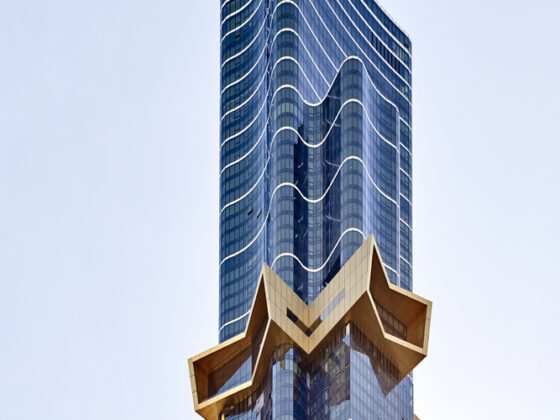
Located on Melbourne’s Southbank, Australia 108 is also the tallest building to roof in the Southern Hemisphere, at 319 metres.
The building contains 1,105 apartments over 100 floors, and unprecedented resident facilities including dining and function spaces, theatrettes, gymnasiums, pools, spas and an extensive barbeque terrace.
Two of the amenities levels are found within the Starburst, which cantilevers eight metres out from the building facade.
Here, residents can relax in a double-height sky garden or enjoy the infinity edge swimming pools.
Offering an unmatched level of luxury, the $25 million penthouse is located across the entirety of level 100.
The penthouse, which offers 360-degree views of Melbourne, is entered through a private lift and triple-height lobby and has access to a sky courtyard.
Paying homage to Melbourne’s traditional heritage, the ground floor podium has been reimagined with new inclusions established around its original façade of a timber mill and warehouse which were constructed in 1899.
Merging modernity with nature, canary palms and trees shroud the 10 carpark levels above the lobby, offering layers of greenery as you
Australia 108 appears as a shining beacon in Melbourne’s city skyline, though both street and twilight experiences were considered by Fender Katsalidis in addition to those at the skyline level and during the daytime.
The oscillating appearance of the glass panels are lined by horizontal white bands constructed from wireframes, glowing and highlighting the curves and contours of the building.
These white bands of light are programmable to form patterns that complement the internally lit Starburst as it glows like a star in the night sky.
“Our purpose is to reveal the essential qualities of place, the landscape, its history, social rituals and cultural significance through design. In this project, the ASPECT-led team is championing a creative solution that enhances the way people interact with several treasured heritage places —while simultaneously creating an accessible piece of infrastructure that meets the urgent needs of a major city in the 21st Century,” continues Coles.
The team will now move on to the concept and detailed design stage of the project, with construction expected to start in 2023.

Project: Sydney Harbour Bridge cycleway
Architects: Aspect Studios, Landscape Architecture
Collaborators: Collins and Turner, Yerrabingin, Design 5 Architects, Eckersley O’Callaghan, JMT Consulting, and Electrolight
Client: City of Sydney