Nantou, Taiwan

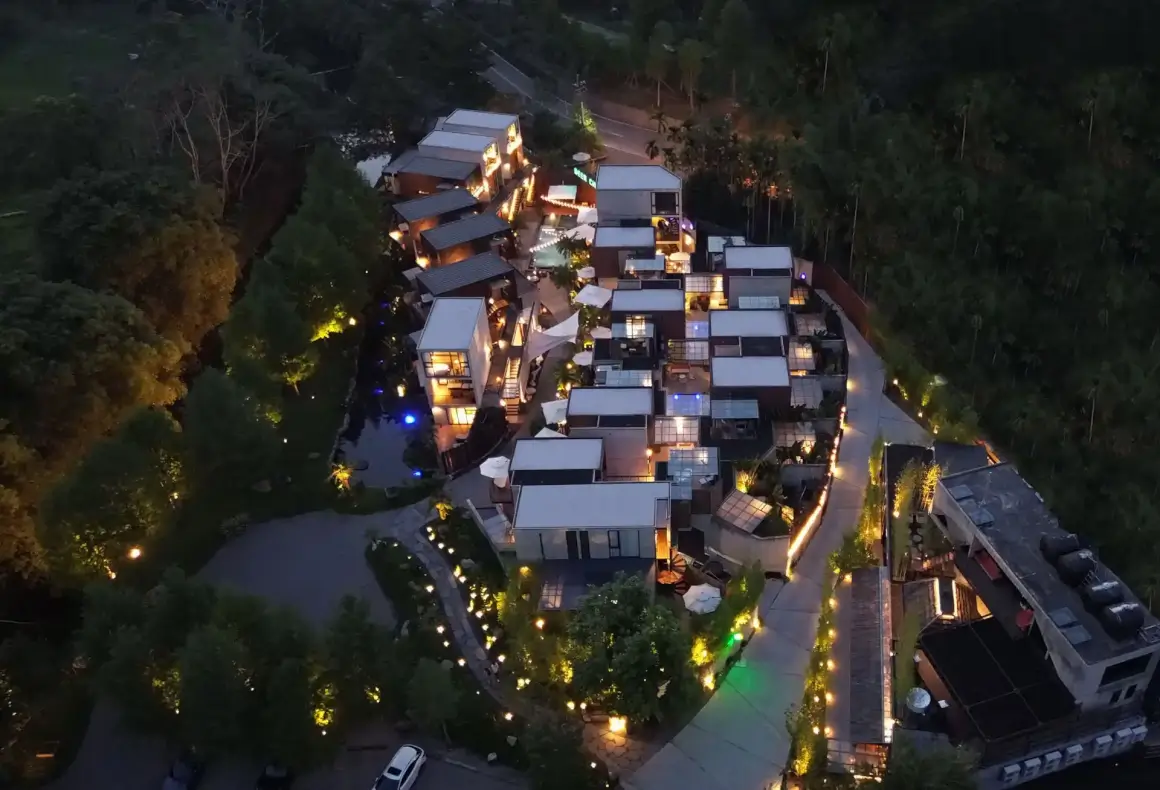
The project aims to create an innovative hotel concept inspired by the rising trend of “Glamping,” focusing on living harmoniously with nature and nurturing human connections. Its design draws from traditional Taiwanese communal spaces, particularly the inner courtyard of a three-section farmhouse and the imagery of people gathering under a tree, shaping unique communal areas.
Resort Deer-Chaser Yuchi won an 2025 International Architecture Award from The Chicago Athenaeum: Museum of Architecture and Design.
This approach honors cultural traditions while challenging conventional hospitality design, offering a refreshing and immersive travel experience in Taiwan. Features like outdoor bathing areas, open common spaces, and private courtyards encourage guests to connect with nature and each other. The design includes open yet private common areas for socializing, wandering, and exploration. Concrete load-bearing wall panels are integrated for both structural strength and visual impact through a stacked configuration.


The concept, “the more local, the more international,” departs from typical hostels by deeply incorporating local culture and environment. Positioned near a natural river, the design emphasizes harmony with nature, inspired by the river and a bald cypress boulevard. This connection underscores the relationship between people and nature, as well as interpersonal connections.
Architectural elements are influenced by traditional Taiwanese farmhouse courtyards and communal spaces under large trees, enhancing spatial openness and fostering emotional connections. The project addresses modern social challenges of technological detachment by encouraging guest interaction within “wild luxury” settings. Outdoor baths and large floor-to-ceiling windows bring guests closer to the environment, while interconnected private courtyards promote community among travelers.
Structurally, the project presents engineering challenges with concrete load-bearing walls, glass partitions, and a steel-framed tree house. It blends traditional Taiwanese living with contemporary glamping, offering a culturally rich lodging experience. The proximity to the river influences the architectural layout, including a meandering entrance passage that mimics the river’s flow, creating alternating constriction and expansion for a dynamic guest experience that fosters a natural relationship.

Materials such as raw concrete, metal, glass, bamboo walls, sleepers, and stainless steel panels form a textural contrast that highlights simplicity. The building volume reflects a modern reinterpretation of the traditional three-section farmhouse, using stacking and interlacing methods to innovate while paying tribute to heritage.
The design focuses on social interaction and relaxation. Inspired by the farmhouse’s inner courtyard, a secluded communal courtyard is created, enclosed by multiple rooms, a clubhouse, and a quiet alley. This setup gives guests a choice between private outdoor retreats and shared social spaces, diverging from typical hotel designs.
An open, unpartitioned area, inspired by groups gathering under a tree, creates a natural, community-oriented atmosphere that blends with the surroundings. The traditional private bathing concept is redefined by placing the bath outdoors on a terrace, enhancing the intimate bond between humans and nature.
Overall, this project fuses cultural tradition with modern design and environmental integration to offer a unique, community-focused glamping experience in Taiwan.

Architects: S.C.A.A.
Lead Architect: Chi-Wei Shi
General Contractor: Chi-Wei Shih
Client: Wright Leisure Co., Ltd.
Photographers: Rex Chu and Shih-Feng Wang