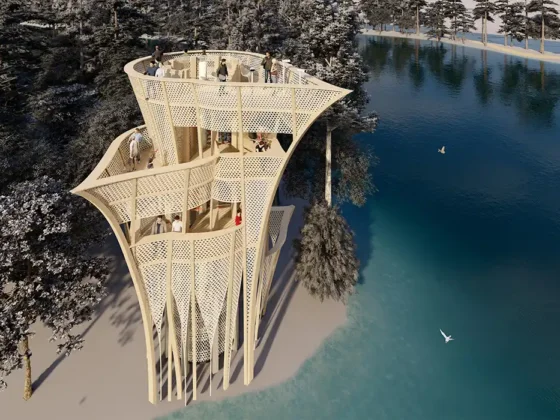
Hsinchu City, Taiwan
German-based Behet Bondzio Lin Architekten designs a building that develops a stack of superimposed inclined walls that give a characteristic aspect to the architecture of the project.

The walls allow a luminous entrance from the sky, bathing the interior environment, illuminating hope with its light, and making a space more welcoming.
The study creates a space where people can feel better despite the situation of loss they are going through.

Mourning rituals involve placing incense, candles, and flowers on the “mountainside”, these practices create a wall and an opportunity for us to lose ourselves in thought.
The wall is an element that builds distance.
In this case, tilting the walls at a different angle creates an image of the mourner gradually moving away. These walls create a starting distance, rather than separation.
The stacking of superimposed inclined walls gives its characteristic appearance to the main volume that is used by the Columbarium program.
This stacking builds a vision of being at the foot of the slope surrounded by mountains.
The walls, leaning and open to the sky, record the sun’s rays that warm the atmosphere and accompany us to face fear.
Perimeter recessed planters bathed in natural light at the base of these sloping walls create a path through which to walk and transport yourself to pleasant stories.


Project: Eternal Hill Columbarium
Architects: Behet Bondzio Lin Architekten
Lead Architect: Yu‐Han Michael Lin
General Contractor: Zhou Shong Co., Ltd
Structural Engineers: Top Technic Engineering Consultant Co., Ltd
Mep Engineering: Ming Jhan Co., Ltd
Photographers: Yu Chen Chao Photography