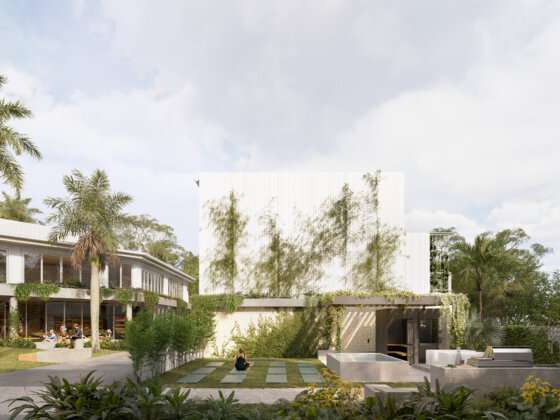
San Juan, Puerto Rico

Category:             Affordable, Social, and Community Living Housing
Year:                 2022
Architects:           Marvel Architects, Landscape Architects, LLP
Architects of Record: Marvel Marchand Architects
Design Team:          Jonathan Marvel, Jose Marchand-Sifre, Héctor J.
Ralat-Sotomayor, Karen J. Cuadro Esteves, Rafael A. Ferrer, Enrique
Ramón-Milián, and José Juan Terrasa-Soler
General Contractor:   Ecobuilders
Client:               Acacia Network
Photographers:        Paola Quevedo Santos
In the aftermath of Hurricanes Irma and Maria, Acacia Network, a New York-based nonprofit founded and operated by Puerto Ricans, mobilized its resources to support families in Puerto Rico who had lost their homes. With decades of experience serving vulnerable communities, Acacia set out to develop a self-sufficient, affordable, and resilient housing prototype. Inspired by the founder’s childhood home in Patillas, the team arrived weeks after Hurricane Maria, meeting with local officials, designers, and builders to launch a permanent housing solution.
Despite major challenges—including post-hurricane recovery, the COVID-19 pandemic, the 2020 earthquakes, inflation, and supply chain disruptions—Acacia completed two homes for low-income families. These prototypes not only addressed critical housing needs but also converted vacant lots into productive community assets. The homes later endured Hurricane Fiona, validating the design’s resilience.


The prototype supports long-term durability and housing security without depending on Puerto Rico’s fragile grid. Designed for affordability, it minimizes square footage while complying with accessibility, energy, and utility standards. Passive strategies—cross ventilation, natural lighting, and thermal comfort—are core features. Louvered doors and windows allow airflow throughout, and a central courtyard improves ventilation and daylight.
Given the region’s climate risks, the home’s envelope and materials withstand extreme weather. Deep eaves protect openings from sun and rain. The system collects, filters, and stores rainwater for up to five days, and solar-ready infrastructure powers two separate load panels—one for heavy loads, the other for lighter, renewable-powered functions.

Adaptability is also key. The base two-bedroom design can expand to three bedrooms. While connected to public utilities, the home’s infrastructure enables reduced consumption and off-grid capability. The water system includes a 1,000-gallon cistern and a 200-gallon tank that filters and recirculates water.
Through modular design, passive cooling, and resilient infrastructure, Acacia Network created a dignified, permanent housing model that supports social equity and climate resilience. The Resilient Home Prototype demonstrates that sustainable, affordable housing is achievable for vulnerable communities living in high-risk environments.