Ningbo, Zhejiang Province, China
“A tribute to “The Butterfly God,” states DDB Architects.
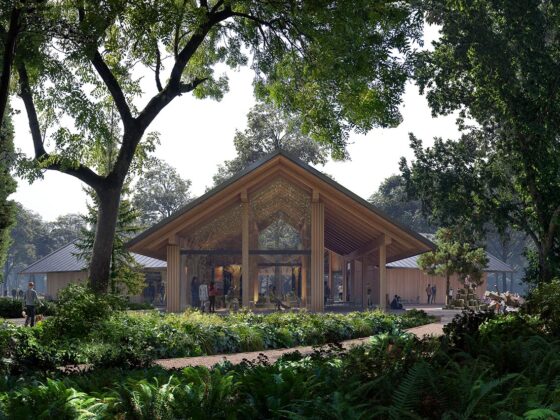
Developed by DDB Architects in collaboration with Sitarch Lab, the new Zhou Yao Insect Museum is the biggest entomological museum in Asia, whose design is inspired by the abstracted butterfly form shown in its collection adopting the “butterfly triangle” as the prototype and using this shape as a metaphor for butterfly wings, as the design motif in the architectural form and layout.

Ningbo Zhouyao Insect Museum is the winning project of a design competition that DDB participated in in 2018.
Professor Zhou Yao is known as the “God of Butterflies” and is an important founder of Chinese insect taxonomy.
During the vicissitudes of nearly a hundred years, he has collected hundreds of thousands of insect specimens, and his investigations have traveled all over China, which has made a great contribution to the cause of entomology in China.
Ningbo Zhou Yao Insect Museum is a museum named after Professor Zhou Yao.
Its original site was established in 1996 and is currently the largest insect museum in Asia named after an individual’s surname.
In order to further enhance and give full play to the scientific and scientific significance of the special field of insects, at the same time,
Mr. Zhou Yao’s own life inspires people, especially the young generation, to forge ahead and actively contribute to the motherland.

The former site of the Insect Museum is planned to be relocated to Yinzhou Park, which is known as Ningbo’s “city green lung,” and the area will also be expanded from 500 square meters to more than 3,000 square meters.
The ultra-light and delicate features of the insect’s wings are embodied in the parametric gradient glazing of the building’s skin.
The architects have created a distinctive form that is not only mimetic but also more in line with the theme of the museum.
Their main concern was to meet the need for modern exhibitions, offering a platform for the general public to see displays, learn, engage, and experience the insects in nature.
The museum is both a thematic museum and a memorial to Professor Zhou Yao who is considered the founding father of Chinese entomology.

The spatial organization of the building is defined by the physical conditions of the site.
Through the integrated design of the indoor exhibition space and the outdoor public space, the layout of the entire site was decided, with an emphasis on the interaction with nature.

At the ground level, various functions are arranged into “butterfly triangles” of varied sizes.
This recreation area, located on the north side of the building, was created by harnessing the 1m difference in elevation between the road and the park to naturally form a series of steps, encouraging various interactions with the space and helping generate a fused indoor-outdoor experience.

The land restraint, the maximized use of space on the first floor, and the facade design altogether create a dynamic overall image for the building.
The design takes advantage of the difference in height to create a 3D butterfly triangle; two full-height traffic spaces — the foyer and the “butterfly valley” — are created at the sides of the building.

The facade facing the city road is light, elegant, and dynamic, projecting a distinct urban image; while on the side facing the waterfront, the facade appears to be dancing, the space is integrated into the park grounds and becomes the stage of the park.

The white glazed glass on the facade creates a soft, almost disappearing effect, forming a sequence of rhythm. In combination with the gradual gradient change of skin units, it weaves a facade that is as light as wings.
Through sophisticated parametric design control, the curtain wall components and divisions between the curtain panels are successfully hidden in the glazed patterns.


Project: Zhou Yao Insect Museum New Building
Architects: DDB Architects and Sitarch Lab (Sidi Architecture)
Lead Architect: Zhepeng Xu
Project Director: Qingyi Ma
Design Team: Ying Zhao, Zixuan Huang, Wenyu Guo, Yaying Zhou, Sheng Jiang, Caixuan Lin, and Rongyao Xu
Construction Drawing Design: Ningbo Urban Construction Design & Research Institute Co.Ltd.
Curtain Wall Design: The Architectural Design & Research Institute of Zhejiang University Co.Ltd.
Client: Ningbo Yincheng Group Co., Ltd.
Photographers: Qingyi Ma