Edmonton, Alberta, Canada
Canadian-based gh3* firm has designed the first naturally filtered outdoor pools, located inside Borden Park, a community park in Edmonton.

The structure consists of a large natural swimming pool, a children’s pool, and a pool house for changing and equipment.
The project replaced an existing pool and ancillary buildings and includes a new change-room pavilion and landscaped pool precinct for 400 swimmers.
The project has been awarded a 2021 International Architecture Award by The Chicago Athenaeum: Museum of Architecture and Design and The European Centre for Architecture Art Design and Urban Studies.

The challenge was to create a large-scale pool with high-quality water control while also achieving an environmentally healthy and natural filtration system.
Canada’s guidelines for public pools are some of the strictest in the world.
To realize the project, the architects needed to take a creative design approach grounded in first principles, a science-based response to the design challenge.
By classifying the project as “recreational waters,” the building permit was issued as a “constructed beach with variances”.
The design process began with developing a pool technology that cleanses the water through stone, gravel, sand, and botanic filtering processes.
Filtration is achieved through a biological-mechanical system: a gravel filter, and a constructed wetland with Zooplankton.
This is an un-sterilized, chemical, and disinfectant-free filtering system that produces ‘living water,’ having a similar quality to natural lake water ubiquitous across Canada.
The unique water treatment system inspired a materials-oriented architectural concept for the entire facility.
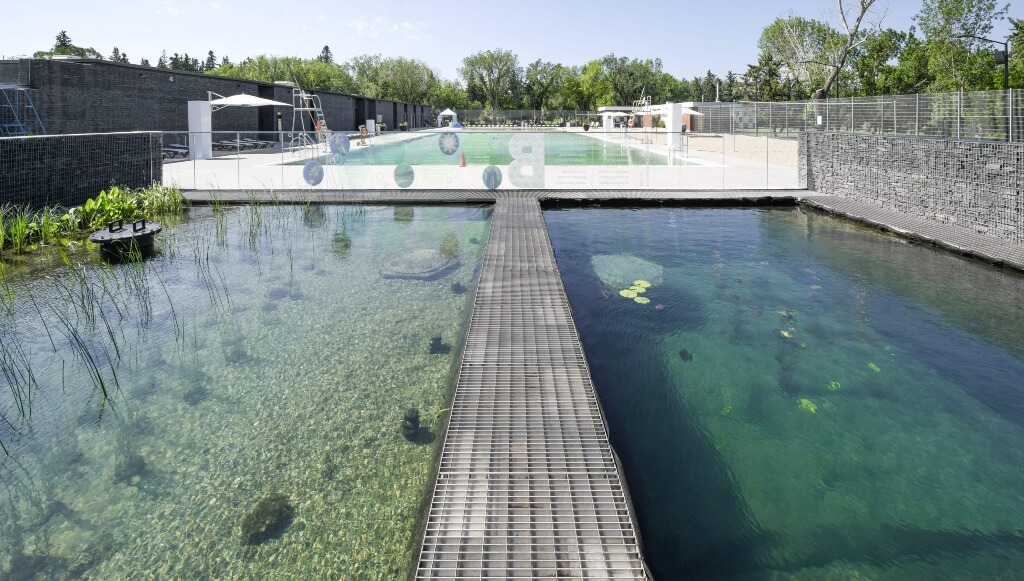
A restrained palette establishes a fundamental conceptual connection between the technical demands of the pool and the design of the built and landscape elements.
The result is a technically rigorous and aesthetically integrated design that visually evokes the idea of filtration.
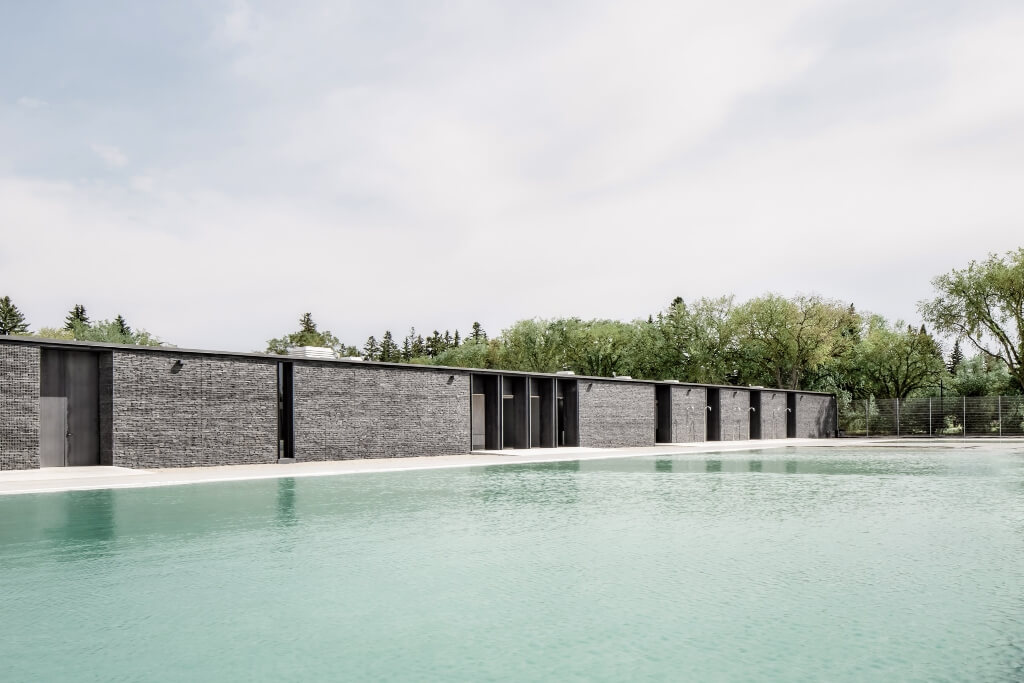
The low-slung pavilion houses universal change rooms, showers, washrooms, staff areas, and water filtration mechanisms.
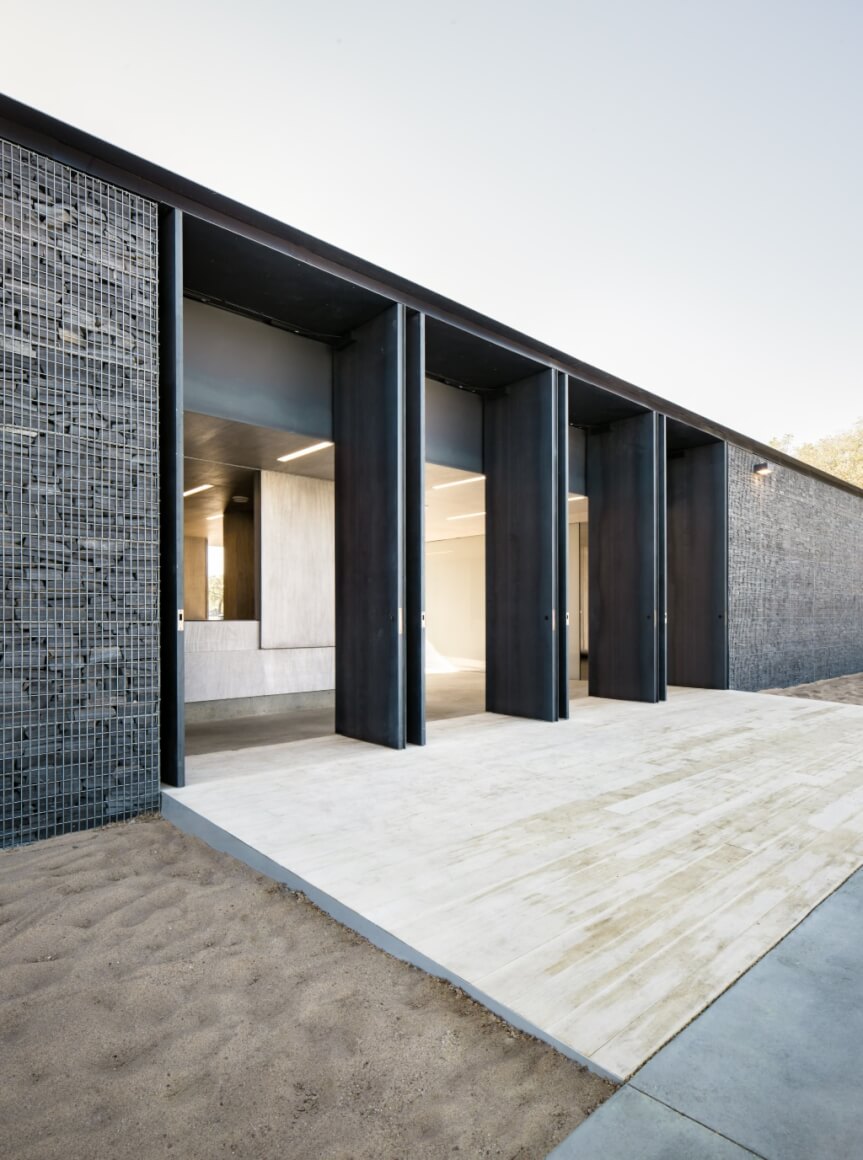
Dark, locally sourced limestone and steel of the gabion wall construction defines the enclosure’s vertical dimension as filter-like or breathable, as granular and porous.
The swimming program includes a children’s pool, a deep pool, on-deck outdoor showers, a sandy beach, picnic areas, and spaces for other pool-related recreational activities.
The pool precinct is defined by a planar landscape where flush to surface detailing creates seamless interfaces between the sandy beach, the concrete pool perimeter, and wood decking.

The gabion walls of the low rectilinear building terminate with a lid-like flat roof that frames the tree-canopy of the park beyond, enhancing the sensation of open-sky spaciousness within the pool precinct.
The elemental form and reductive materials ease the user experience and enrich the narrative of bathing in the landscape.
The juxtaposition of the constructed elements invokes comparisons with the geology of the local North Saskatchewan River and the flat topography of Alberta’s prairie lands edge.
As a seasonal facility, the construction and systems were designed to require minimal maintenance and low energy.
Passive primary strategies were adopted where possible, including cooling and ventilation.
The gabion walls keep the interior space cool during the hot summer months while allowing ample natural ventilation due to their porous nature.
Further energy-saving measures include high-efficiency condensing natural gas boilers, LED lighting, and high-efficiency water pumps coupled with a gravity-fed design. EnergyPlus was used for the energy model, along with EnerPool for the pool estimates.
The project was modeled according to LEED Canada NC-2009 methodologies. Energy data presented is per unit of conditioned area, which is small relative to the overall facility; most of this energy use is related to the pool and associated systems.
Canada’s official GHG inventory documents were used as sources for emissions factors. Charging stations for electric vehicles were included in the facility.
The massive gabion walls of the exterior envelope are constructed from local stone; they can easily be disassembled and the materials reused at the end of building life.
The steel doors and gabion baskets are made from recycled material and are recyclable. The primary interior finish is FSC-certified marine-grade plywood.
All materials have an exceptionally long life and require little maintenance.
The sand was chosen as the main landscaping material as, when carried into the concrete pools on people’s feet, it acts as a natural abrasive device to remove algae that can build in the chemical-free water.
Although safe, users often perceive algae growth as unhealthy or unsanitary.
Natural pool operators, therefore, spend time and energy removing algae buildup mechanically.
The continuous abrasion of sand against the pool floor significantly reduces the buildup of algae through natural means.
This increase in amenity emerges from a design that also costs the local authority less to operate and maintain than the facility it replaced while eliminating the toxic burden a conventional outdoor pool imposes on the surrounding environment.
The project introduces a novel typology to the Canadian context.
The successful realization of the project on budget and schedule, and delivering exceptional quality in its architectural design, has generated broader interest in the development of similarly sustainable projects within the country and internationally.

Project: Borden Park Natural Swimming Pool
Architects: gh3*
Client: City of Edmonton
General Contractor: Ellis Don
Structural Engineers: Morrison Hershfield
Photographers: Raymond Chow @gh3